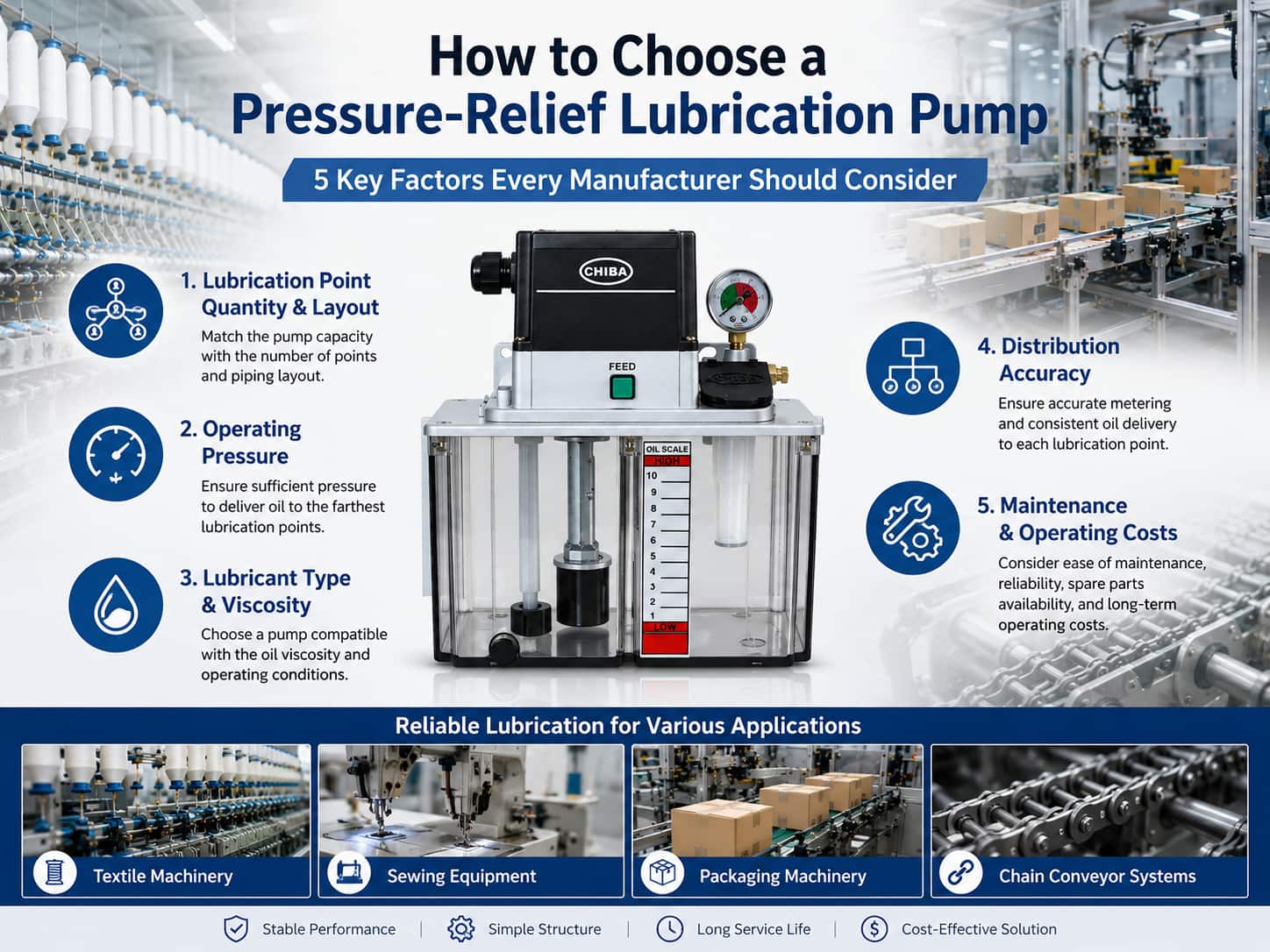
How to Choose a Pressure-Relief Lubrication Pump: 5 Key Factors Every Manufacturer Should Consider
Introduction: Selecting the Right Lubrication Pump Is More Important Than You Think
Lubrication systems are often overlooked when designing or maintaining industrial machinery, yet they play a critical role in determining equipment reliability, maintenance frequency, and overall production efficiency. A properly selected lubrication pump ensures that moving components receive the right amount of lubricant at the right time, helping reduce friction, minimize wear, and extend equipment life.
Among various lubrication technologies, pressure-relief lubrication pumps remain a popular choice for textile machinery, sewing equipment, packaging machines, chain conveyors, and other light industrial applications. Their simple structure, stable oil distribution, and cost-effective operation make them a practical solution for manufacturers seeking reliable lubrication without excessive complexity.
However, choosing the wrong lubrication pump can result in uneven oil distribution, insufficient lubrication at critical points, increased downtime, and unnecessary maintenance costs. Before investing in a pressure-relief lubrication system, manufacturers should evaluate several key factors to ensure the system matches their operational requirements.
1. Lubrication Point Quantity and Distribution Layout
Why More Lubrication Points Do Not Always Mean a Bigger Pump
One of the most common misconceptions when selecting a lubrication pump is assuming that a machine with more lubrication points automatically requires a larger pump. In reality, the effectiveness of a pressure-relief lubrication system is often determined more by the piping layout than by the number of lubrication points.
For example, a packaging machine may have only 10 to 15 lubrication points, but if those points are spread across a long conveyor line, the system may experience higher resistance than a textile machine with 30 lubrication points located close together.
When evaluating a lubrication system, engineers should consider:
- Main pipeline length
- Number of branch lines
- Distance to the furthest lubrication point
- Number of distributors
- Future expansion requirements
A well-designed lubrication layout ensures that lubricant reaches every point consistently, preventing under-lubrication in remote areas of the machine.
Practical Example
Consider a carton packaging line with multiple conveyor sections. If the lubrication system is not designed to account for long pipe runs, bearings near the pump may receive sufficient oil while those at the end of the line receive very little. Over time, this uneven distribution can lead to premature bearing failures and unexpected downtime.
2. Operating Pressure Requirements
The Hidden Cost of Insufficient Lubrication Pressure
Pressure is one of the most critical specifications in any pressure-relief lubrication system.
The pump must generate enough pressure to overcome resistance throughout the piping network while delivering lubricant to the furthest lubrication points. If the operating pressure is insufficient, lubrication performance can deteriorate long before maintenance personnel notice any visible symptoms.
In many factories, pressure-related lubrication issues first appear as:
- Increased bearing temperatures
- Chain wear and elongation
- Higher operating noise
- Reduced component lifespan
- Frequent maintenance interventions
Because these symptoms often develop gradually, insufficient lubrication pressure can remain unnoticed until equipment damage has already occurred.
Why Pressure Matters in Resistance-Type Systems
Pressure-relief lubrication systems commonly use resistance-type distributors that allocate oil according to outlet hole size. To achieve accurate distribution, the system must maintain adequate pressure throughout the entire network. Without sufficient pressure, the proportional distribution principle cannot function as intended.
For this reason, buyers should evaluate not only maximum pump pressure but also the actual pressure requirements of their complete lubrication network.
3. Lubricant Type and Viscosity
Why Lubricant Selection Directly Affects Pump Performance
Even when using the same lubrication system, different lubricants can produce dramatically different results.
The viscosity of the lubricant influences:
- Flow rate
- Distribution accuracy
- Pipeline resistance
- Startup performance
- Overall system efficiency
Different applications often require different lubricant grades:
| Lubricant Grade | Typical Application |
|---|---|
| ISO VG 32 | High-speed textile machinery |
| ISO VG 68 | General packaging equipment |
| ISO VG 150 | Heavy-duty chain conveyor systems |
As lubricant viscosity increases, the system generally experiences:
- Slower flow rates
- Higher pressure requirements
- Increased pipeline resistance
- Greater demands on pump performance
Therefore, equipment manufacturers should determine lubricant specifications during the design stage rather than after installation.
Temperature Considerations
Environmental conditions also affect lubricant behavior. In colder environments, oil viscosity increases, potentially reducing flow. In high-temperature applications, lubricant stability becomes equally important. Selecting a pump compatible with the intended operating conditions helps ensure consistent performance throughout the year.
4. Distribution Accuracy and Metering Performance
Why Consistent Oil Distribution Matters More Than Maximum Flow Rate
When comparing lubrication systems, many buyers focus on flow rate. However, for resistance-type lubrication systems, distribution accuracy is often far more important than total output volume.
The purpose of a lubrication system is not simply to deliver oil—it is to deliver the correct amount of oil to each lubrication point.
For example, in textile machinery:
- Excessive lubrication can contaminate products and waste oil.
- Insufficient lubrication can accelerate bearing wear and increase downtime.
A pressure-relief lubrication system addresses this challenge through proportional oil distribution based on outlet hole size.
This approach allows different lubrication points to receive different oil volumes according to their requirements without requiring complex electronic controls.
Why Accurate Distribution Improves Machine Reliability
Consistent lubrication helps:
- Reduce uneven component wear
- Extend bearing life
- Lower maintenance costs
- Improve machine stability
- Reduce lubricant consumption
Over time, these benefits can have a significant impact on overall production efficiency.
5. Maintenance Requirements and Operating Costs
Looking Beyond the Initial Purchase Price
While purchase price is always a consideration, experienced manufacturers understand that total ownership cost is often more important than initial investment.
A lower-cost lubrication system may appear attractive at first, but if it requires frequent maintenance or causes recurring lubrication issues, the long-term costs can quickly exceed the initial savings.
When evaluating a lubrication pump, buyers should consider:
- Oil refill frequency
- Maintenance accessibility
- Component replacement costs
- Downtime risks
- Energy consumption
- Spare parts availability
Why Simplicity Remains an Advantage
One reason pressure-relief lubrication systems remain widely used in light industrial applications is their straightforward design.
Compared with more complex lubrication technologies, they typically offer:
- Easier installation
- Simpler maintenance
- Lower operating costs
- Proven long-term reliability
For textile machinery, sewing equipment, packaging machines, and chain conveyors, these practical advantages continue to make pressure-relief systems a preferred choice.
Typical Applications for Pressure-Relief Lubrication Pumps
Pressure-relief lubrication systems are particularly suitable for equipment requiring continuous, reliable oil delivery.
| Industry | Typical Equipment |
|---|---|
| Textile Industry | Spinning machines, weaving machines, knitting equipment |
| Sewing Industry | Industrial sewing machines and automated sewing systems |
| Packaging Industry | Filling machines, labeling machines, carton sealers |
| Material Handling | Chain conveyors and transfer systems |
| Light Manufacturing | Assembly equipment and production machinery |
These industries benefit from the system's ability to provide stable lubrication while maintaining low operating costs and simple maintenance requirements.
Why Many Manufacturers Continue to Choose Pressure-Relief Lubrication Systems
Despite the emergence of increasingly sophisticated lubrication technologies, pressure-relief lubrication systems remain a trusted solution because they deliver exactly what many light industrial applications require:
- Stable and reliable oil distribution
- Simple installation and operation
- Effective cooling performance
- Lower maintenance costs
- Long service life
- Excellent cost-performance ratio
For many manufacturers, these advantages outweigh the additional complexity associated with more advanced lubrication systems.
How YUNG TIEN MACHINERY INDUSTRY CO., LTD. Supports Industrial Lubrication Needs
At YUNG TIEN MACHINERY INDUSTRY CO., LTD., we specialize in lubrication pumps and lubrication system solutions for a wide range of industrial applications.
Our pressure-relief lubrication systems are designed to provide:
- Proportional oil distribution based on outlet size
- Stable oil delivery performance
- Simple and reliable system architecture
- Effective cooling benefits
- Easy maintenance and long service life
These characteristics make our systems particularly suitable for textile machinery, sewing equipment, packaging machines, chain conveyors, and other light industrial equipment requiring dependable lubrication.
Conclusion
Selecting a pressure-relief lubrication pump involves much more than choosing a pump size or reservoir capacity. Manufacturers should carefully evaluate lubrication point layout, operating pressure requirements, lubricant compatibility, distribution accuracy, and long-term maintenance costs before making a decision.
By understanding these five key factors, equipment manufacturers and maintenance professionals can choose a lubrication system that improves reliability, extends equipment lifespan, and supports efficient production operations.
For expert guidance on selecting the right lubrication solution for your application, YUNG TIEN MACHINERY INDUSTRY CO., LTD. is ready to help you find the most effective and economical system for your machinery.