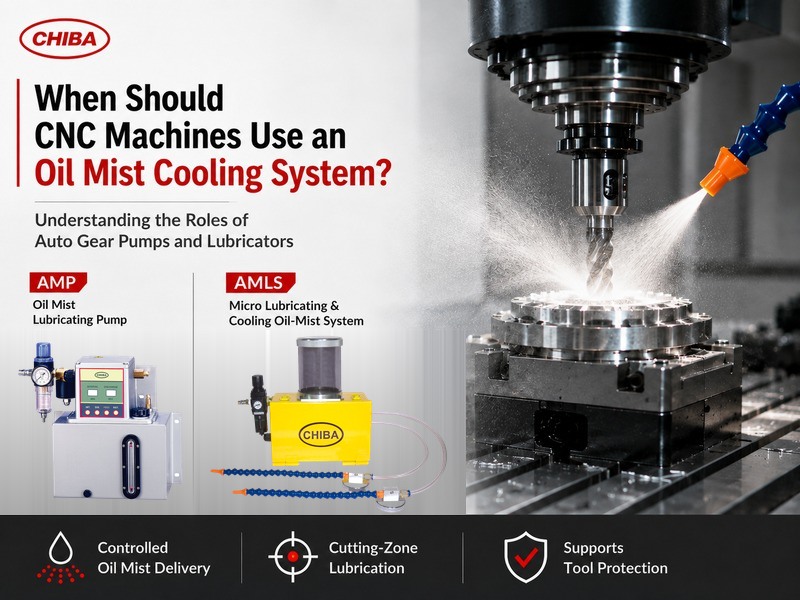
When Should CNC Machines Use an Oil Mist Cooling System? Understanding the Roles of Auto Gear Pumps and Lubricators
CNC machining generates friction and heat at the cutting zone, especially in high-speed or precision cutting applications. In these situations, manufacturers may need a controlled way to deliver lubricant directly to the cutting area without relying on excessive lubricant volume.
An oil mist cooling system combines a controlled lubricant supply with compressed air to direct a fine oil mist toward the cutting zone. Depending on the machining process and system configuration, this approach can support localized lubrication and contribute to cooling around the tool and workpiece.
At YUNG TIEN LUBRICATION TECHNOLOGY CO., LTD., we manufacture lubrication systems and related components for industrial applications. Our oil mist product range includes the AMP Oil Mist Lubricating Pump and AMLS Micro Lubricating & Cooling Oil-Mist System, designed for applications requiring controlled lubrication and cooling around the machining area.
This guide explains when an oil mist cooling system may be suitable for CNC machining, how an auto gear pump functions within the system, where a lubricator fits within machine lubrication, and what manufacturers should evaluate before selecting an oil mist solution.
Table of Contents
- When Should a CNC Machine Use an Oil Mist Cooling System?
- How Does an Oil Mist Cooling System Work in CNC Machining?
- What Role Does an Auto Gear Pump Play in an Oil Mist Cooling System?
- Where Does a Lubricator Fit in CNC Lubrication and Cutting Applications?
- Which CNC Machining Applications and Conditions Are Suitable for Oil Mist Cooling?
- What Should You Check Before Choosing an Oil Mist Cooling System?
- YUNG TIEN Oil Mist Solutions for CNC Cutting Applications
- Frequently Asked Questions About Oil Mist Cooling Systems
1. When Should a CNC Machine Use an Oil Mist Cooling System?
A CNC machine may be suitable for an oil mist cooling system when the cutting process requires localized lubrication, controlled lubricant delivery, and compressed-air-assisted delivery around the cutting zone.
Typical situations include:
- High-speed or precision cutting applications
- Cutting processes that generate concentrated heat around the tool
- Applications where lubricant needs to reach a specific cutting zone
- Processes that benefit from controlled lubricant delivery rather than excessive oil volume
However, an oil mist system should not be selected simply because the machine is CNC-controlled. Suitability depends on the cutting process, tooling, workpiece material, lubricant, compressed-air supply, machine enclosure, spray-point arrangement, and required cooling method.
Key Takeaways
- Oil mist cooling is most relevant when localized lubrication and cooling are required.
- High-speed and precision cutting are common application areas.
- The actual machining conditions should determine whether the system is suitable.
2. How Does an Oil Mist Cooling System Work in CNC Machining?
An oil mist cooling system combines lubricant delivery with compressed air to direct a fine oil mist toward the machining area.
Lubricant Supply → Pump → Compressed Air → Oil Mist → Cutting Zone
The lubricant helps reduce friction at the tool–workpiece and tool–chip interfaces, while compressed air carries the lubricant toward the cutting zone and can contribute to localized cooling.
The actual cooling effect depends on the machining process, air supply, lubricant, spray arrangement, and overall system configuration. Oil mist should therefore not be treated as equivalent to every conventional flood-cooling method.
Lubricant quantity also needs to match the application. Too little lubricant may not provide sufficient lubrication, while excessive oil delivery can reduce the advantages of a controlled micro-lubrication approach.
Spray position is equally important. Even when the pump and air supply operate correctly, poor nozzle positioning may prevent lubricant from reaching the actual cutting interface.
YUNG TIEN's AMLS Micro Lubricating & Cooling Oil-Mist System allows oil quantity and air quantity to be adjusted and is intended for micro-lubrication and cooling applications, including high-speed precision cutting.
Important Factors in Oil Mist Delivery
- Lubricant type and viscosity
- Oil delivery quantity
- Air pressure and air volume
- Spray direction and nozzle position
- Distance to the cutting zone
- Number of spray points
- Cutting speed and machining conditions
Key Takeaways
- An oil mist cooling system should be viewed as a complete delivery system.
- The pump and compressed-air supply must work together with the lubricant and spray arrangement.
- Nozzle position and machining conditions directly affect whether lubricant reaches the required cutting zone.
3. What Role Does an Auto Gear Pump Play in an Oil Mist Cooling System?
An auto gear pump can serve as the lubricant supply element in certain oil mist systems. Its main function is to provide a stable and repeatable lubricant supply before the lubricant is combined with compressed air.
The gear pump itself does not create the complete lubrication and cooling effect. It is one component within the oil mist delivery system.
In YUNG TIEN's AMP Oil Mist Lubricating Pump, a gear pump works together with compressed air to form oil mist for lubrication and cutting applications.
Depending on the selected model, the AMP series includes PLC-controlled and internally timed configurations, while liquid-level monitoring is available on applicable configurations.
Why Stable Lubricant Delivery Matters
- Supports consistent lubricant supply
- Helps maintain repeatable lubrication cycles
- Supports predictable oil mist formation
- Allows controlled oil delivery to the spray system
- Can be integrated with machine control requirements
Pump output should still be matched to the actual process. A higher-capacity pump is not automatically better when the machining application requires only a small, controlled amount of lubricant.
Key Takeaways
- The gear pump supplies lubricant to the system.
- Compressed air assists with oil mist formation and delivery.
- Pump output and control should match the machining requirements.
- The gear pump is only one part of the complete oil mist system.
Related Reading: Optimizing Industrial Performance: From Fuel Oil Dispenser to Advanced Lubrication Systems
4. Where Does a Lubricator Fit in CNC Lubrication and Cutting Applications?
The term lubricator covers a broad range of lubrication equipment and should not be treated as the opposite of an oil mist cooling system.
A CNC machine may require different lubrication methods for different areas of the equipment. One system may supply oil or grease to machine components such as:
- Linear guides
- Bearings
- Sliding components
- Ball screws
- Other machine lubrication points
Another lubrication system may be dedicated specifically to the cutting zone.
A conventional centralized lubricator generally supplies lubricant to machine components at controlled intervals or according to machine operating conditions. An oil mist cooling system, by contrast, can be used around the cutting zone where lubricant and compressed air need to be directed toward the machining interface.
YUNG TIEN's product range includes oil lubrication systems, grease lubrication systems, air systems, oil mist cooling systems, recycle systems, distributors, accessories, and related tubing.
For this reason, manufacturers should not simply ask, “Which lubricator is better?” A more useful question is “Which lubrication method is required for each part of the machine?”
An oil mist cooling system may therefore complement an existing centralized lubrication system rather than replace it.
Key Takeaways
- A lubricator is a broad category of lubrication equipment.
- Machine-component lubrication and cutting-zone lubrication can require different systems.
- Oil mist cooling does not automatically replace an existing centralized lubrication system.
Related Reading: Resistance vs. Pressure-Relief: Selecting the Right Quantitative Lubrication Pump for Your System
5. Which CNC Machining Applications and Conditions Are Suitable for Oil Mist Cooling?
Oil mist cooling is particularly relevant when a machining process benefits from controlled lubrication at the cutting zone. YUNG TIEN's AMLS product information identifies high-speed precision cutting as an application for micro oil-mist lubrication and cooling.
High-Speed Cutting
As cutting speed increases, friction and heat may rise around the cutting edge. A controlled lubricant supply directed toward the cutting zone can help reduce friction and support more stable machining conditions.
Precision Machining
Applications with demanding dimensional accuracy or surface-finish requirements may benefit from more controlled lubrication around the cutting interface. Actual results still depend on tooling, workpiece material, cutting parameters, and thermal conditions.
Localized Cutting Zones
Oil mist is most useful when the spray can be directed toward the actual tool–workpiece or tool–chip interface. If the cutting zone is difficult to reach or the spray direction changes during machining, another nozzle or hose arrangement may be required.
Applications Requiring Controlled Lubricant Delivery
Oil mist systems may be suitable when the process requires a controlled quantity of lubricant rather than unrestricted oil delivery.
The required amount depends on:
- Machining method
- Cutting tool
- Workpiece material
- Spindle or tool speed
- Feed rate
- Lubricant properties
- Cutting-zone accessibility
Machines With Suitable Compressed-Air Supply
Compressed air is part of the oil mist delivery process. Available air pressure, volume, quality, and connection requirements therefore need to be evaluated before system selection.
When Oil Mist May Not Be Suitable
- The machining process requires another cooling method.
- The cutting tool manufacturer specifies a different lubrication approach.
- Compressed air is unavailable or unsuitable.
- Spray positioning cannot reliably reach the cutting zone.
- The selected lubricant is not suitable for oil-mist application.
- The machine enclosure or workplace cannot appropriately manage generated mist or aerosol.
Key Takeaways
- Oil mist cooling is a process-specific solution rather than a universal CNC lubrication method.
- Tooling, workpiece material, lubricant, air supply, and spray position should be evaluated together.
- Another cooling or lubrication method may be more appropriate when oil mist cannot meet the application requirements.
6. What Should You Check Before Choosing an Oil Mist Cooling System?
Once oil mist appears suitable for the machining process, the next step is to confirm the technical, control, and installation requirements.
1. Lubricant Type
Confirm: The lubricant recommended for the machine, cutting tool, and machining process.
Why It Matters: Lubricant compatibility can affect the cutting process, system components, seals, and delivery performance. Do not change lubricant solely to suit the pump without confirming compatibility.
2. Required Oil Delivery
Confirm: The amount of lubricant that needs to reach the cutting zone.
Why It Matters: The correct quantity depends on the machining process. Selecting the highest available pump output does not necessarily improve lubrication.
3. Compressed-Air Supply
Confirm: Available air pressure, air volume, air quality, and connection requirements.
Why It Matters: Compressed air is part of the oil-mist delivery process. For the AMP Oil Mist Lubricating Pump, YUNG TIEN's published specification lists an applied-pressure range of 1–7 kg/cm².
4. Number and Position of Spray Points
Confirm: How many cutting locations require lubrication and whether the spray can remain directed toward the cutting area.
Why It Matters: Oil mist needs to reach the intended cutting interface. The AMLS Micro Lubricating & Cooling Oil-Mist System includes configurations with one or two spray bars, depending on the model.
5. Voltage
Confirm: Machine and power-supply voltage.
Why It Matters: Electrical compatibility must be checked before installation. The AMLS series includes 110V and 220V configurations.
6. Control Method
Confirm: Whether lubrication will be controlled through a PLC, internal timer, machine operating cycle, or another suitable method.
Why It Matters: The lubrication cycle needs to match machine operation. The AMP series includes PLC-controlled and internally timed models.
7. Reservoir Capacity and Level Monitoring
Confirm: Required reservoir capacity and whether lubricant-level monitoring is needed.
Why It Matters: Reservoir capacity affects installation space and refill frequency. AMLS models are available with 1 L or 2 L tank configurations, while applicable AMP configurations include a float switch for liquid-level monitoring.
8. Hose and Spray Configuration
Confirm: Hose routing, spray position, and machine movement.
Why It Matters: The arrangement should allow lubricant to reach the cutting zone without interfering with machine movement.
9. Mist Control and Workplace Requirements
Confirm: Machine enclosure, ventilation or extraction, lubricant safety information, workplace requirements, and applicable regulations.
Why It Matters: Oil mist or aerosol generated during machining needs to be appropriately managed according to the application and workplace environment. Follow the machine manufacturer's instructions, lubricant safety information, and applicable workplace requirements.
Selection Checklist
- CNC machine type
- Machining process
- Workpiece material
- Cutting tool information
- Lubricant type
- Required lubrication location
- Number of spray points
- Available air pressure
- Voltage
- Available installation space
- Required control method
- Machine enclosure or mist-control arrangement
Related Reading: Lubrication Pump Replacement Guide: What to Check Before Replacing an Obsolete or Failed Unit
7. YUNG TIEN Oil Mist Solutions for CNC Cutting Applications
At YUNG TIEN LUBRICATION TECHNOLOGY CO., LTD., our lubrication product range covers oil lubrication, grease lubrication, air systems, oil mist cooling systems, recycle systems, distributors, accessories, and related tubing.
For CNC cutting applications involving controlled oil-mist delivery, two relevant solutions are the AMP and AMLS series.
AMP Oil Mist Lubricating Pump
The AMP Oil Mist Lubricating Pump combines a gear pump with compressed air to form oil mist.
Published configurations include:
- PLC-controlled models
- Internally timed models
- Float switch on applicable configurations
- Published applied-pressure range of 1–7 kg/cm²
- Related flexible spray-hose fittings
The system is intended for oil-mist lubrication and cutting applications where controlled lubricant delivery is required.
View AMP Oil Mist Lubricating Pump →
AMLS Micro Lubricating & Cooling Oil-Mist System
The AMLS Micro Lubricating & Cooling Oil-Mist System is designed for micro-lubrication and cooling around the machining area.
Published configurations include:
- One or two spray bars
- 110V or 220V
- 1 L or 2 L tank options
- Adjustable oil and air delivery
- Application to high-speed precision cutting
View AMLS Micro Lubricating & Cooling Oil-Mist System →
Neither series should be selected from the model name alone. Suitability depends on the machining process, lubricant requirement, compressed-air supply, number of spray points, electrical system, control method, installation space, and mist-management requirements.
When contacting YUNG TIEN, provide your machine type, machining process, lubricant, compressed-air conditions, and control requirements so we can better evaluate the application.
Key Takeaways
- AMP combines a gear pump and compressed air as part of its oil mist delivery design.
- AMLS focuses on adjustable micro-lubrication and cooling for machining applications.
- Product selection should be based on actual CNC machining conditions rather than model specifications alone.
8. Frequently Asked Questions About Oil Mist Cooling Systems
Q1. Is an oil mist cooling system suitable for every CNC machine?
Answer:
No. Suitability depends on the machining process, tool, workpiece material, lubricant, compressed-air supply, spray arrangement, machine enclosure, and required cooling method.
Q2. Does an oil mist cooling system replace a conventional lubricator?
Answer:
Not necessarily. A conventional lubricator may supply oil or grease to machine components such as guides, bearings, or other lubrication points, while an oil mist cooling system may serve the cutting area.
A CNC machine can therefore use different lubrication methods for different purposes.
Q3. Why does an oil mist cooling system use compressed air?
Answer:
Compressed air helps carry and distribute lubricant toward the cutting zone and supports oil-mist delivery. Required pressure and air volume depend on the system and machining application.
Q4. What does an auto gear pump do in an oil mist cooling system?
Answer:
The gear pump supplies lubricant to the system. In YUNG TIEN's AMP Oil Mist Lubricating Pump, it works together with compressed air to form oil mist for lubrication and cutting applications.
Q5. What information should I provide when selecting an oil mist system for a CNC machine?
Answer:
Provide information about the CNC machine, machining process, tool and workpiece, lubricant, available compressed air, required spray points, voltage, control method, installation space, and mist-management conditions.
These details help determine whether the system matches the actual machining requirements.
Choosing an Oil Mist Cooling System Based on the Cutting Process
An oil mist cooling system can be a practical solution when a CNC machining process requires localized and controlled lubrication around the cutting zone.
However, system performance depends on more than the pump itself. The auto gear pump, lubricant, compressed-air supply, spray arrangement, control method, tooling, and machining conditions all need to work together.
Likewise, a lubricator used for machine-component lubrication may serve a different purpose and does not automatically compete with or replace an oil mist system.
At YUNG TIEN LUBRICATION TECHNOLOGY CO., LTD., we recommend evaluating the actual CNC machining conditions before selecting an oil mist solution. Providing detailed application information allows us to better assess the lubrication configuration required for the machine and cutting process.
Need Help Evaluating an Oil Mist Cooling System?
If you are evaluating an oil mist solution for a CNC machine, provide your machine type, machining process, lubricant, compressed-air conditions, spray-point requirements, and control specifications. Our team can review the application information and help evaluate an appropriate lubrication solution for your requirements.
More Articles
Optimizing Industrial Performance: From Fuel Oil Dispenser to Advanced Lubrication Systems
Learn about auto pumps, auto gear pumps, lubricators, and different industrial lubrication approaches.
Resistance vs. Pressure-Relief: Selecting the Right Quantitative Lubrication Pump for Your System
Understand how resistance-type and pressure-relief lubrication systems differ in operating and distribution principles.
Lubrication Pump Replacement Guide: What to Check Before Replacing an Obsolete or Failed Unit
Review the specifications and system conditions that should be checked before replacing an industrial lubrication pump.